

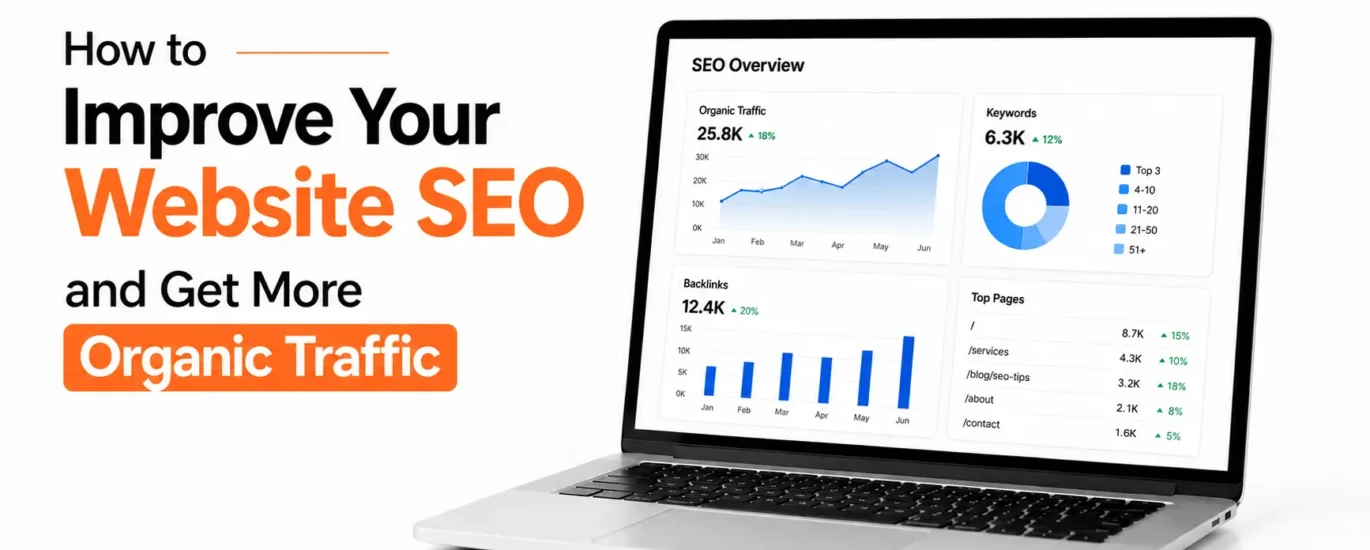
If you want more people to discover your business online, improving your website SEO is one of the most effective long-term strategies. A freelance digital marketing expert in Kochi can help businesses build an SEO strategy that improves search visibility, attracts the right audience, and generates consistent organic traffic without depending entirely on paid advertising.
But SEO is not simply about adding keywords to a website. Search engines evaluate many factors, including content quality, website structure, page experience, relevance, authority, and how effectively a page answers the user’s search intent.
The good news is that you don’t need to change everything at once. By following a systematic SEO strategy, you can gradually improve your website’s visibility and attract more qualified visitors.
What Is Website SEO?
Website SEO, or Search Engine Optimization, is the process of improving a website so that search engines can understand its content and show its pages to relevant users.
A strong SEO strategy focuses on three major areas:
- On-page SEO – Optimizing content, headings, keywords, images, URLs, and internal links.
- Technical SEO – Improving website speed, mobile usability, crawlability, indexing, and technical structure.
- Off-page SEO – Building authority through backlinks, mentions, citations, and other external signals.
The goal is simple: help search engines understand your website and help users find the information they need.
Why Is SEO Important for Organic Traffic?
Organic traffic refers to visitors who reach your website through unpaid search results.
For example, someone searches:
“digital marketing expert in Kochi”
If your website appears among the relevant search results, that person may click on your website without you paying for every visit.
SEO can help you:
- Increase website visibility
- Attract relevant visitors
- Generate qualified leads
- Build brand credibility
- Improve long-term online visibility
- Reduce dependence on paid advertising
- Reach customers actively searching for your services
However, SEO is a long-term process. Consistent optimization and useful content are usually more valuable than trying to achieve quick ranking improvements.
10 Effective Ways to Improve Your Website SEO
1. Start With Proper Keyword Research
Keyword research is the foundation of an effective SEO strategy.
Before creating or optimizing a page, identify what your target audience is actually searching for.
Instead of targeting only broad keywords such as:
“digital marketing”
consider more specific search terms such as:
- digital marketing services in Kochi
- freelance digital marketer in Kochi
- SEO expert in Kochi
- website SEO services
- local SEO services in Kochi
Long-tail keywords can be especially useful because they often have clearer search intent.
How to Find the Right Keywords
You can use tools such as Google Keyword Planner, Google Search Console, Google Trends, and other SEO platforms to identify:
- Search demand
- Keyword variations
- Related queries
- Search intent
- Ranking opportunities
Don’t choose keywords only because they have high search volume. Relevance and search intent matter just as much.
2. Create Content That Matches Search Intent
One of the biggest SEO mistakes is creating content without understanding what the user actually wants.
Search intent generally falls into four categories:
Informational Intent
The user wants information.
Example:
“How does SEO work?”
Navigational Intent
The user wants to find a particular website or page.
Example:
“Google Search Console login”
Commercial Intent
The user is researching before making a purchase.
Example:
“Best SEO services in Kochi”
Transactional Intent
The user is ready to take action.
Example:
“Hire an SEO expert in Kochi”
Your content should provide the answer that matches the user’s intent.
This is also important for AEO (Answer Engine Optimization) because AI-powered search experiences increasingly prioritize content that directly answers user questions.
3. Optimize Your Page Title and Meta Description
Your title and meta description help users understand what your page is about before clicking.
A good SEO title should:
- Clearly describe the page
- Include the primary keyword naturally
- Be compelling
- Match search intent
- Avoid unnecessary keyword repetition
For example:
How to Improve Your Website SEO & Get More Organic Traffic
Your meta description should briefly explain the benefit of visiting the page.
Avoid stuffing keywords into the title or description. Write for humans first while keeping search relevance in mind.
4. Use a Clear Heading Structure
A well-structured page is easier for both users and search engines to understand.
Use:
H1 – Main page topic
H2 – Major sections
H3 – Supporting topics
For this article:
H1: How to Improve Your Website SEO and Get More Organic Traffic
H2: Why Is SEO Important for Organic Traffic?
H2: 10 Effective Ways to Improve Your Website SEO
H3: Start With Proper Keyword Research
This structure also helps AI search systems identify specific sections and extract useful answers.
5. Improve Your On-Page SEO
On-page SEO involves optimizing the visible and behind-the-scenes elements of your webpage.
Important elements include:
- SEO title
- Meta description
- H1 and subheadings
- Primary and secondary keywords
- URL structure
- Image alt text
- Internal links
- Content structure
- Relevant entities and concepts
Don’t force keywords into every paragraph.
Instead, use related terms naturally.
For example, if your primary topic is website SEO, related terms may include:
- search engine optimization
- organic search
- search rankings
- keyword research
- technical SEO
- SEO content
- website visibility
- search intent
This creates topical relevance without keyword stuffing.
6. Make Your Website Mobile-Friendly
A large portion of internet users access websites through smartphones.
If your website is difficult to use on mobile devices, visitors may leave quickly.
Check whether:
- Text is easy to read
- Buttons are easy to tap
- Images fit the screen
- Navigation is simple
- Pages load quickly
- Forms work correctly
- Content doesn’t overflow horizontally
A responsive website creates a better experience for both users and search engines.
7. Improve Website Speed and Core Web Vitals
Website performance can influence the overall page experience.
A slow website can lead to:
- Higher bounce rates
- Poor user experience
- Lower engagement
- Fewer conversions
To improve performance, consider:
- Compressing images
- Using modern image formats
- Removing unnecessary plugins
- Reducing unused scripts
- Using browser caching
- Improving hosting performance
- Minimizing large page elements
Tools such as Google PageSpeed Insights can help identify performance problems.
8. Build a Strong Internal Linking Strategy
Internal links connect one page of your website to another.
For example, if you have a blog about SEO, you could internally link to your:
- SEO services page
- Local SEO page
- Digital marketing services page
- Contact page
- Related SEO articles
Internal linking helps users discover more useful content and helps search engines understand the relationship between pages.
A Simple Internal Linking Strategy
Whenever you publish a new article:
- Link to relevant older articles.
- Add links from older articles to the new article.
- Use descriptive anchor text.
- Avoid excessive internal links.
- Prioritize genuinely useful connections.
This can help create a stronger website structure.
9. Create Helpful, Original and People-First Content
Publishing hundreds of low-quality articles isn’t a sustainable SEO strategy.
Instead, focus on creating content that genuinely helps your audience.
Before publishing a blog, ask:
Does this article answer the user’s question clearly?
Does it provide useful information that is easy to understand?
Does it offer practical examples?
Does it cover the topic sufficiently?
Would someone find this content useful enough to share or bookmark?
A good article should provide more value than simply repeating information that already exists online.
This approach is particularly important for AIO (AI Optimization) because AI-powered search systems need clear, reliable, well-structured information to understand and summarize.
10. Strengthen Your Local SEO
If your business serves a specific geographic area, local SEO can help you appear in location-based searches.
For example:
“freelance digital marketing expert in Kochi”
has a much stronger local intent than simply:
“digital marketing expert.”
To improve local SEO:
- Optimize your Google Business Profile
- Keep your business information consistent
- Add relevant business categories
- Collect genuine customer reviews
- Create location-relevant content
- Build relevant local citations
- Add your location naturally to important website pages
- Use location-based keywords where relevant
Avoid creating multiple pages simply by changing the city name. Each location page should provide genuinely useful, location-specific information.
How Does AEO Help Your Website?
AEO stands for Answer Engine Optimization.
Instead of focusing only on traditional search rankings, AEO focuses on making your content easy for answer engines and AI-powered search systems to understand.
For example, instead of writing:
“SEO is important for businesses.”
you could provide a direct answer:
“SEO helps businesses increase organic visibility, attract relevant website visitors, and generate potential leads from search engines.”
Then expand on the topic with supporting information.
AEO Best Practices
Use:
- Direct answers
- Question-based headings
- Short paragraphs
- Lists
- Tables where appropriate
- Clear definitions
- FAQs
- Relevant examples
- Structured content
This makes your content easier to understand and extract.
What Is GEO in SEO?
GEO, or Generative Engine Optimization, focuses on improving the likelihood that your content can be understood, referenced, or surfaced by generative AI search experiences.
To make content more AI-friendly:
- Provide clear factual information
- Answer specific questions
- Demonstrate expertise
- Use logical content structures
- Support claims with trustworthy information
- Cover related subtopics
- Keep information updated
- Avoid vague or repetitive writing
The goal isn’t to write exclusively for AI.
Create excellent content for people first, and structure it so machines can understand it easily.
How AIO Can Improve Search Visibility
AIO (AI Optimization) involves preparing your website content for AI-powered discovery and search experiences.
A well-optimized article should clearly communicate:
Who – Who is the content for?
What – What question does it answer?
Why – Why is the information useful?
How – How can the reader implement it?
This creates content that is easier for users, search engines, and AI systems to understand.
Don’t Forget Off-Page SEO
On-page optimization is important, but website authority also matters.
Off-page SEO can include:
- Earning quality backlinks
- Digital PR
- Business citations
- Brand mentions
- Relevant industry listings
- Guest contributions
- Content promotion
Focus on quality and relevance rather than simply trying to collect a large number of backlinks.
A few relevant and trustworthy links can be more valuable than many low-quality links.
How Long Does SEO Take to Increase Organic Traffic?
There is no guaranteed timeframe for SEO results.
The timeline can depend on factors such as:
- Website age
- Existing authority
- Competition
- Content quality
- Technical condition
- Backlink profile
- Search demand
- Industry
- SEO consistency
Some improvements may become visible relatively quickly, while competitive keywords can take considerably longer.
The best approach is to monitor performance consistently and improve the strategy based on actual data.
How to Measure Your SEO Performance
You cannot improve what you don’t measure.
Important SEO metrics include:
Organic Traffic
Shows how many visitors arrive through search engines.
Keyword Rankings
Shows where your pages appear for target queries.
Click-Through Rate
Shows how often users click your result after seeing it.
Impressions
Shows how frequently your pages appear in search results.
Conversions
Measures whether organic visitors are taking valuable actions such as:
- Calling your business
- Sending an enquiry
- Filling out a form
- Purchasing a product
- Booking a service
Tools You Can Use
Useful tools include:
- Google Search Console
- Google Analytics
- Google Business Profile
- Google Keyword Planner
- PageSpeed Insights
- SEO crawling and auditing tools
Don’t focus only on rankings. Traffic quality and conversions are ultimately more important than a position number.
Common SEO Mistakes to Avoid
If you want sustainable organic growth, avoid these common mistakes:
Keyword Stuffing
Repeating the same keyword excessively can make content unnatural.
Duplicate Content
Publishing substantially similar content across multiple pages can create confusion and reduce the value of those pages.
Ignoring Search Intent
Even a well-optimized page may struggle if it doesn’t answer what the searcher wants.
Neglecting Technical SEO
Broken links, indexing problems, slow pages, and mobile issues can affect website performance.
Buying Low-Quality Backlinks
Poor-quality links can create unnecessary SEO risks.
Publishing Content Without a Strategy
Creating random blog posts without understanding your audience, keywords, and search intent wastes resources.
Ignoring Local SEO
Businesses serving specific locations should take advantage of location-based search opportunities.
SEO Checklist for Better Organic Traffic
Before publishing or optimizing a page, use this simple checklist:
☑ Primary keyword identified
☑ Search intent understood
☑ SEO-friendly title created
☑ Meta description optimized
☑ One clear H1 used
☑ Relevant H2 and H3 headings added
☑ Keyword used naturally
☑ Related keywords included
☑ Content provides genuine value
☑ Images optimized
☑ Alt text added where appropriate
☑ Internal links included
☑ Mobile experience checked
☑ Page speed reviewed
☑ URL is clear and descriptive
☑ Local SEO optimized where relevant
☑ Content reviewed for accuracy
☑ Search performance monitored after publishing
Frequently Asked Questions About Website SEO
How can I improve my website SEO?
Start with keyword research and search intent, then improve your page titles, headings, content, internal links, technical performance, mobile experience, and website authority. Monitor your results through tools such as Google Search Console and Analytics.
How can I get more organic traffic to my website?
Create helpful content targeting relevant search queries, optimize existing pages, improve technical SEO, build quality backlinks, strengthen internal linking, and consistently update your content based on search performance.
Is SEO better than paid advertising?
SEO and paid advertising serve different purposes. SEO can generate long-term organic visibility, while paid advertising can provide faster visibility. Many businesses benefit from combining both strategies.
How important are keywords for SEO?
Keywords remain important because they help connect your content with relevant search queries. However, modern SEO should focus on search intent, topic relevance, content quality, and user experience rather than keyword repetition.
Does website speed affect SEO?
Website performance contributes to the overall user experience. Improving page speed can help visitors access and interact with your content more easily.
What is the difference between SEO and AEO?
SEO focuses broadly on improving visibility in search engines. AEO focuses more specifically on structuring content so that direct answers can be understood and surfaced by answer engines and AI-powered search experiences.
What is GEO in digital marketing?
GEO, or Generative Engine Optimization, focuses on making content more understandable and useful for generative AI search systems. It emphasizes clear answers, strong topical coverage, trustworthy information, and structured content.
Final Thoughts
Improving website SEO is not about finding one secret technique that suddenly puts your website at the top of Google. Sustainable SEO comes from combining high-quality content, strong on-page optimization, technical performance, search intent, internal linking, authority building, and continuous measurement.
If you are a small business owner, freelancer, or service provider in Kochi, focusing on local search opportunities can make your SEO strategy even more effective. Start with the pages that are most important to your business, identify the keywords your potential customers use, improve the content, and track the results.
Most importantly, don’t optimize only for search engines. Optimize for the people who are searching. When your website provides clear, useful, trustworthy answers, you create a stronger foundation for organic visibility across traditional search, answer engines, and AI-powered search experiences.
If you need professional support to improve your website visibility, a freelance digital marketing expert in Kochi can help you develop a practical SEO strategy based on your business goals, target audience, competition, and search opportunities.